Where to stay in Fes: a medina guide
Where to sleep in Fes el Bali, Fes el Jdid or the Ville Nouvelle, how to arrive by train, bus or plane, and when to go. A practical guide with sources.
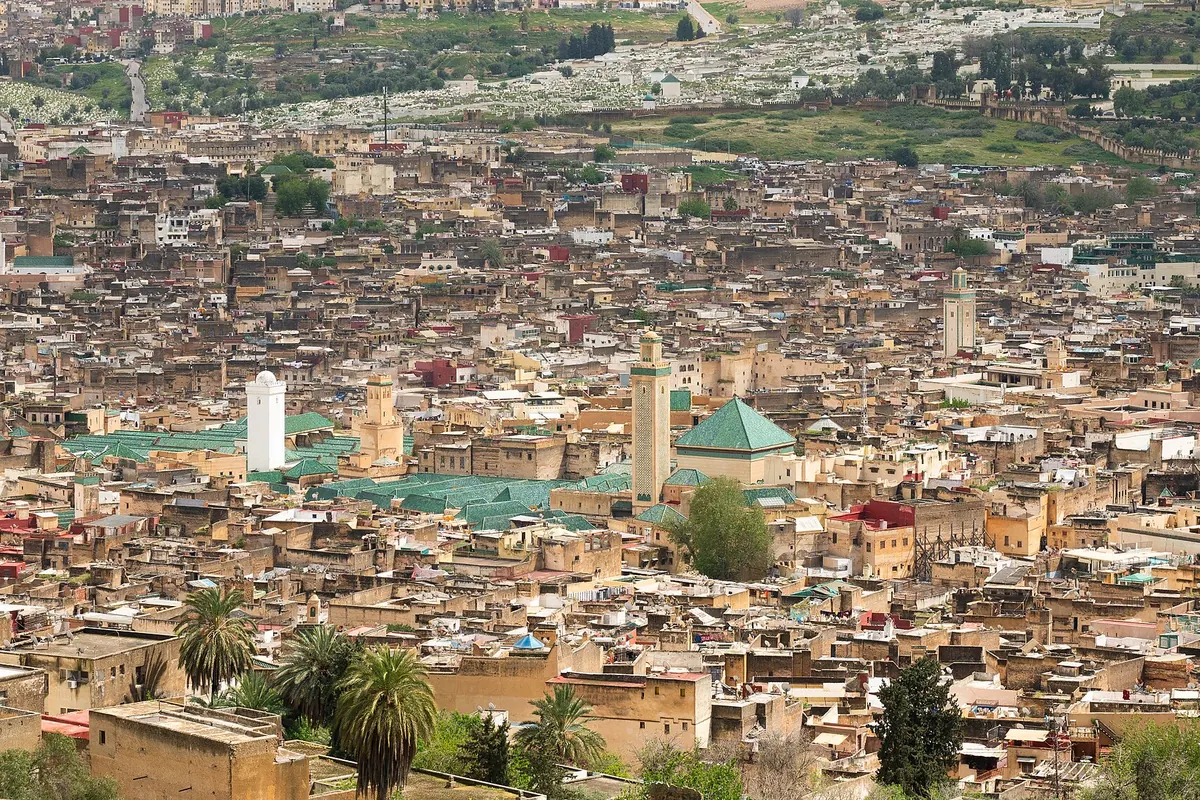 Photo: Petar Milošević, CC BY-SA 4.0
Esta guía todavía no está en español. Te mostramos la versión en inglés.
Fes is not one city but three, laid side by side. Fes el Bali is the walled medina, founded under the Idrisids in the 9th century. Fes el Jdid, the “new” city, dates to 1276 — new only by comparison. The Ville Nouvelle is the French-era town of wide avenues [1][3]. Where you sleep decides which Fes you wake up in, so this guide takes the three areas in turn.
Short answer. Stay inside Fes el Bali, in a riad or a family-run dar, for a first visit and for the Fes most people come for. The practical end of the medina is around Bab Bou Jeloud, the western gate: easier to reach with luggage, and the medina's two main lanes run down from it into the centre [1][2]. If you have a car, an early train, or you want modern hotel comfort, sleep in the Ville Nouvelle and taxi in [1].
Inside Fes el Bali
The medina is a UNESCO World Heritage site, inscribed in 1981, and one of the largest car-free urban areas in the world, with some 9,400 lanes [2][3]. No car reaches your door: arrange for the riad to meet you at a gate, or hire a porter for your bags [1]. Around you are al-Qarawiyyin, founded in 859 by Fatima al-Fihri and recognised by UNESCO and Guinness as the oldest continuously operating educational institution in the world [3]; Chouara, the largest of the city's three tanneries [2]; and the Bou Inania and al-Attarine madrasas, which are open to all visitors [2]. Orientation trick: the two Talaa lanes, Kebira and Sghira, run downhill from Bab Bou Jeloud toward the Qarawiyyin quarter — downhill takes you into the centre, uphill takes you back out [2]. Best for: first visits, short stays, atmosphere.
Fes el Jdid and the Batha edge
Fes el Jdid was founded in 1276 as the royal city [3]. It holds the Royal Palace at Place des Alaouites, whose seven brass doors are an exterior stop, and the Mellah, the historic Jewish quarter [2]. The Jnan Sbil gardens sit between the two medinas and give you shade and quiet in the middle of the day [2]; the Al Batha Museum, in a former palace, is on this side too [2]. Streets here can be reached by car, so arrivals and departures are easier than deep inside el Bali, while Bab Bou Jeloud and the old medina are a short walk away. Best for: medina access with calmer logistics, longer stays.
The Ville Nouvelle
The French-built new town is a different world: wide avenues, cafés, parking, lifts, and modern hotels [1]. The train station is here [1], and a short taxi ride takes you to the medina gates [1]. You trade atmosphere for ease, and for many travellers that trade is worth it. Best for: drivers, families, business stops, very early or late trains.
Getting there
- By train: Fes has a mainline station in the Ville Nouvelle, on the ONCF network toward Tangier, Rabat–Casablanca and Marrakech. Journey times are roughly 3.5 to 4 hours to Casablanca, 3.5 to 4.5 hours to Tangier (the fastest route changes onto the Al Boraq high-speed line at Kenitra) and about 6.5 hours direct to Marrakech; check current timetables on oncf.ma before you travel.
- By bus: coaches link Fes with the north. The Fes to Chefchaouen CTM run covered in our Chefchaouen guide takes 4 to 4.5 hours at about 110 to 140 MAD per person; book at least two days ahead, especially the 11:00 departure [5].
- By plane: Fes-Saïss airport (FEZ) lies about 15 km south of the old town, 25 to 30 minutes by road. Taxis from the airport run on a fixed fare agreed with the driver rather than a meter: expect roughly 120 to 200 MAD into town, and agree the price before you get in. Whichever way you arrive, set up your data before you land with our Morocco eSIM guide.
When to go
Spring and autumn are mild and are the comfortable default for most visitors. Summer is hot; the lowest room prices tend to come in July and August, because of the heat, and again in the cooler, rainier weeks of January and February [4]. Winter days are quiet in the medina and the light is beautiful, but pack for rain.
Good to know
You will get pleasantly lost in Fes el Bali; everyone does. Use the Talaa rule above, and agree your riad's meeting gate before you arrive, because cars stop at the gates [1][2]. For sunset, climb to the Marinid tombs on the northern hill: the whole bowl of the medina lies below you [2]. Working mosques in Morocco are generally not open to non-Muslim visitors, so plan to admire al-Qarawiyyin from its gateways; the madrasas beside it welcome everyone [2]. One last thing, because Fes does this to people: if a medina stroll turns into browsing riads for sale, our kawnium guide to Morocco's land-title (ANCFCC) fees explains what registration actually costs before you dream too far.
Sources
- Morocco Guide – Where to Stay in Fes: Medina Riads vs Ville Nouvelle (read 1 November 2026)
- Quartz Mountain – Fes, Morocco Travel Guide (read 1 November 2026)
- Slow Morocco – Fes, The Living Medina (read 1 November 2026)
- MileHacker – Where to Stay in Fes: Hotels, Neighborhoods, Accommodation (read 1 November 2026)
- Sahla Trip – Where to stay in Chefchaouen: a medina guide (our own guide, for the Fes to Chefchaouen bus figures; published 25 October 2026)
Fès n'est pas une seule ville, mais trois, posées côte à côte. Fès el Bali est la médina fortifiée, fondée sous les Idrissides au IXe siècle. Fès el Jdid, la ville « nouvelle », date de 1276 — nouvelle seulement par comparaison. La Ville Nouvelle est la ville de l'époque française, aux larges avenues [1][3]. L'endroit où vous dormez décide de la Fès dans laquelle vous vous réveillez : ce guide passe donc les trois quartiers en revue.
Réponse courte. Dormez dans Fès el Bali, dans un riad ou un dar familial, pour une première visite et pour la Fès que la plupart des voyageurs viennent chercher. Le bout pratique de la médina se situe autour de Bab Bou Jeloud, la porte ouest : plus facile à atteindre avec des bagages, et les deux rues principales de la médina en descendent vers le centre [1][2]. Si vous avez une voiture, un train tôt le matin, ou si vous voulez le confort d'un hôtel moderne, dormez dans la Ville Nouvelle et prenez un taxi [1].
Dans Fès el Bali
La médina est classée au patrimoine mondial de l'UNESCO depuis 1981, et c'est l'une des plus grandes zones urbaines sans voitures au monde, avec quelque 9 400 ruelles [2][3]. Aucune voiture n'arrive jusqu'à votre porte : demandez au riad de venir vous chercher à une porte, ou engagez un porteur pour vos bagages [1]. Autour de vous : la Qarawiyyin, fondée en 859 par Fatima al-Fihri et reconnue par l'UNESCO et le Guinness comme la plus ancienne institution d'enseignement en activité continue au monde [3] ; Chouara, la plus grande des trois tanneries de la ville [2] ; et les médersas Bou Inania et al-Attarine, ouvertes à tous les visiteurs [2]. Astuce d'orientation : les deux Talaa, Kebira et Sghira, descendent de Bab Bou Jeloud vers le quartier de la Qarawiyyin — descendre mène au centre, monter ramène vers la sortie [2]. Idéal pour : une première visite, un court séjour, l'atmosphère.
Fès el Jdid et le côté Batha
Fès el Jdid a été fondée en 1276 comme ville royale [3]. Elle abrite le Palais royal à la place des Alaouites, dont les sept portes de laiton se visitent de l'extérieur, et le Mellah, l'ancien quartier juif [2]. Les jardins Jnan Sbil, entre les deux médinas, offrent ombre et calme au milieu de la journée [2] ; le musée Al Batha, installé dans un ancien palais, se trouve aussi de ce côté [2]. Les rues ici sont accessibles en voiture, donc arrivées et départs sont plus simples qu'au cœur de Fès el Bali, tandis que Bab Bou Jeloud et la vieille médina sont à quelques minutes à pied. Idéal pour : l'accès à la médina avec une logistique plus calme, les séjours plus longs.
La Ville Nouvelle
La ville nouvelle construite par les Français est un autre monde : larges avenues, cafés, parkings, ascenseurs et hôtels modernes [1]. La gare s'y trouve [1], et un court trajet en taxi vous mène aux portes de la médina [1]. Vous échangez l'atmosphère contre la facilité, et pour beaucoup de voyageurs l'échange en vaut la peine. Idéal pour : les automobilistes, les familles, les étapes affaires, les trains très tôt ou très tard.
Comment y aller
- En train : Fès a une gare principale dans la Ville Nouvelle, sur le réseau ONCF vers Tanger, Rabat–Casablanca et Marrakech. Les durées sont d'environ 3,5 à 4 heures pour Casablanca, 3,5 à 4,5 heures pour Tanger (l'itinéraire le plus rapide change pour la ligne à grande vitesse Al Boraq à Kénitra) et environ 6,5 heures en direct pour Marrakech ; vérifiez les horaires actuels sur oncf.ma avant de partir.
- En bus : les autocars relient Fès au nord. La liaison CTM Fès–Chefchaouen présentée dans notre guide de Chefchaouen prend de 4 à 4,5 heures à environ 110 à 140 MAD par personne ; réservez au moins deux jours à l'avance, surtout le départ de 11 h [5].
- En avion : l'aéroport de Fès-Saïss (FEZ) se trouve à environ 15 km au sud de la vieille ville, soit 25 à 30 minutes par la route. Les taxis depuis l'aéroport fonctionnent à prix forfaitaire convenu avec le chauffeur plutôt qu'au compteur : prévoyez environ 120 à 200 MAD pour aller en ville, et convenez du prix avant de monter. Quelle que soit votre façon d'arriver, préparez vos données avant d'atterrir avec notre guide eSIM pour le Maroc.
Quand partir
Le printemps et l'automne sont doux et constituent le choix confortable pour la plupart des visiteurs. L'été est chaud ; les prix des chambres sont au plus bas en juillet et août, à cause de la chaleur, puis pendant les semaines plus fraîches et plus pluvieuses de janvier et février [4]. Les journées d'hiver sont calmes dans la médina et la lumière est belle, mais prévoyez de quoi vous protéger de la pluie.
Bon à savoir
Vous vous perdrez agréablement dans Fès el Bali ; cela arrive à tout le monde. Utilisez la règle des Talaa ci-dessus, et convenez de la porte de rendez-vous avec votre riad avant d'arriver, car les voitures s'arrêtent aux portes [1][2]. Pour le coucher du soleil, montez aux tombeaux mérinides sur la colline au nord : toute la cuvette de la médina s'étend sous vos yeux [2]. Les mosquées en activité au Maroc ne sont en général pas ouvertes aux visiteurs non musulmans : prévoyez d'admirer la Qarawiyyin depuis ses portes ; les médersas voisines accueillent tout le monde [2]. Une dernière chose, car Fès fait cet effet : si une promenade dans la médina se transforme en visite de riads à vendre, notre guide kawnium sur les frais de titre foncier (ANCFCC) au Maroc explique ce que l'enregistrement coûte réellement, avant de rêver trop loin.
Sources
- Morocco Guide – Where to Stay in Fes: Medina Riads vs Ville Nouvelle (consultée le 1er novembre 2026, en anglais)
- Quartz Mountain – Fes, Morocco Travel Guide (consultée le 1er novembre 2026, en anglais)
- Slow Morocco – Fes, The Living Medina (consultée le 1er novembre 2026, en anglais)
- MileHacker – Where to Stay in Fes: Hotels, Neighborhoods, Accommodation (consultée le 1er novembre 2026, en anglais)
- Sahla Trip – Où dormir à Chefchaouen : guide de la médina (notre propre guide, pour les chiffres du bus Fès–Chefchaouen ; publié le 25 octobre 2026)
Fez no es una sola ciudad, sino tres, una junto a otra. Fez el Bali es la medina amurallada, fundada bajo los idrisíes en el siglo IX. Fez el Jdid, la ciudad «nueva», data de 1276, nueva solo en comparación. La Ville Nouvelle es la ciudad de la época francesa, de avenidas anchas [1][3]. El lugar donde duerma decide en qué Fez se despertará, así que esta guía recorre las tres zonas por orden.
Respuesta corta. Duerma dentro de Fez el Bali, en un riad o en una dar familiar, para una primera visita y para la Fez que la mayoría viene a buscar. El extremo práctico de la medina está en torno a Bab Bou Jeloud, la puerta oeste: más fácil de alcanzar con equipaje, y las dos calles principales de la medina bajan desde allí hacia el centro [1][2]. Si tiene coche, un tren temprano o quiere la comodidad de un hotel moderno, duerma en la Ville Nouvelle y vaya en taxi [1].
Dentro de Fez el Bali
La medina es Patrimonio Mundial de la UNESCO desde 1981 y una de las zonas urbanas sin coches más grandes del mundo, con unas 9.400 callejuelas [2][3]. Ningún coche llega hasta su puerta: pida al riad que le recoja en una puerta o contrate a un porteador para las maletas [1]. A su alrededor están la Qarawiyyin, fundada en 859 por Fátima al-Fihri y reconocida por la UNESCO y Guinness como la institución educativa en funcionamiento continuo más antigua del mundo [3]; Chouara, la mayor de las tres curtidurías de la ciudad [2]; y las madrasas Bou Inania y al-Attarine, abiertas a todos los visitantes [2]. Truco de orientación: las dos Talaa, Kebira y Sghira, bajan desde Bab Bou Jeloud hacia el barrio de la Qarawiyyin: bajar le lleva al centro, subir le saca de la medina [2]. Ideal para: primeras visitas, estancias cortas y ambiente.
Fez el Jdid y el borde de Batha
Fez el Jdid se fundó en 1276 como ciudad real [3]. Alberga el Palacio Real en la plaza de los Alauitas, cuyas siete puertas de latón son una parada exterior, y la Mellah, el histórico barrio judío [2]. Los jardines Jnan Sbil se sitúan entre las dos medinas y ofrecen sombra y tranquilidad a mitad del día [2]; el Museo Al Batha, en un antiguo palacio, también está en este lado [2]. A estas calles se puede llegar en coche, así que las llegadas y salidas son más fáciles que en el corazón de el Bali, mientras que Bab Bou Jeloud y la medina antigua quedan a un paseo corto. Ideal para: acceso a la medina con logística más tranquila y estancias más largas.
La Ville Nouvelle
La ciudad nueva construida por los franceses es otro mundo: avenidas anchas, cafés, aparcamiento, ascensores y hoteles modernos [1]. La estación de tren está aquí [1], y un trayecto corto en taxi le lleva a las puertas de la medina [1]. Cambia ambiente por comodidad, y para muchos viajeros el cambio merece la pena. Ideal para: conductores, familias, paradas de negocios y trenes muy tempranos o muy tardíos.
Cómo llegar
- En tren: Fez tiene una estación principal en la Ville Nouvelle, en la red de ONCF hacia Tánger, Rabat–Casablanca y Marrakech. Los tiempos de viaje son de unas 3,5 a 4 horas a Casablanca, de 3,5 a 4,5 horas a Tánger (la ruta más rápida cambia a la línea de alta velocidad Al Boraq en Kenitra) y unas 6,5 horas directas a Marrakech; consulte los horarios actuales en oncf.ma antes de viajar.
- En autobús: los autobuses conectan Fez con el norte. La ruta de CTM entre Fez y Chefchaouen que recoge nuestra guía de Chefchaouen dura de 4 a 4,5 horas y cuesta unos 110 a 140 MAD por persona; reserve con al menos dos días de antelación, sobre todo la salida de las 11:00 [5].
- En avión: el aeropuerto de Fez-Saïss (FEZ) está a unos 15 km al sur del casco antiguo, 25 a 30 minutos por carretera. Los taxis desde el aeropuerto funcionan con una tarifa fija acordada con el conductor en lugar de taxímetro: cuente con unos 120 a 200 MAD hasta la ciudad y acuerde el precio antes de subir. Llegue como llegue, prepare sus datos antes de aterrizar con nuestra guía de eSIM para Marruecos.
Cuándo ir
La primavera y el otoño son suaves y son la opción cómoda para la mayoría de visitantes. El verano es caluroso; los precios de las habitaciones tienden a ser más bajos en julio y agosto por el calor, y de nuevo en las semanas más frescas y lluviosas de enero y febrero [4]. Los días de invierno son tranquilos en la medina y la luz es hermosa, pero lleve ropa para la lluvia.
Conviene saber
Se perderá agradablemente en Fez el Bali; le pasa a todo el mundo. Use la regla de las Talaa de arriba y acuerde con su riad la puerta de encuentro antes de llegar, porque los coches se detienen en las puertas [1][2]. Para el atardecer, suba a las tumbas meriníes de la colina norte: todo el cuenco de la medina se extiende bajo usted [2]. Las mezquitas en activo en Marruecos no suelen estar abiertas a visitantes no musulmanes, así que planee admirar la Qarawiyyin desde sus puertas; las madrasas vecinas reciben a todo el mundo [2]. Una última cosa, porque Fez hace ese efecto: si un paseo por la medina se convierte en mirar riads en venta, nuestra guía de kawnium sobre los costes del título de propiedad (ANCFCC) en Marruecos explica lo que cuesta realmente el registro antes de soñar demasiado lejos.
Fuentes
- Morocco Guide – Where to Stay in Fes: Medina Riads vs Ville Nouvelle (consultada el 1 de noviembre de 2026, en inglés)
- Quartz Mountain – Fes, Morocco Travel Guide (consultada el 1 de noviembre de 2026, en inglés)
- Slow Morocco – Fes, The Living Medina (consultada el 1 de noviembre de 2026, en inglés)
- MileHacker – Where to Stay in Fes: Hotels, Neighborhoods, Accommodation (consultada el 1 de noviembre de 2026, en inglés)
- Sahla Trip – Dónde alojarse en Chefchaouen: guía de la medina (nuestra propia guía, por los datos del autobús Fez–Chefchaouen; publicada el 25 de octubre de 2026)
فاس ليست مدينة واحدة، بل ثلاث مدن متجاورة. فاس البالي هي المدينة القديمة المسوّرة، تأسست في عهد الأدارسة في القرن التاسع. وفاس الجديد تعود إلى عام 1276، وهي «جديدة» بالمقارنة فقط. أما المدينة الجديدة (Ville Nouvelle) فهي مدينة العهد الفرنسي ذات الشوارع الواسعة [1][3]. مكان نومك يحدد أيّ فاس تستيقظ فيها، لذلك يتناول هذا الدليل المناطق الثلاث بالترتيب.
الجواب المختصر. أقم داخل فاس البالي، في رياض أو دار عائلية، في زيارتك الأولى ولأجل فاس التي يأتي معظم الناس من أجلها. الطرف العملي من المدينة القديمة يقع حول باب بو الجلود، الباب الغربي: يسهل الوصول إليه بالأمتعة، وتنحدر منه الطلعتان الرئيسيتان نحو الوسط [1][2]. وإذا كانت معك سيارة، أو قطار مبكر، أو أردت راحة الفنادق الحديثة، فنَم في المدينة الجديدة وادخل بسيارة أجرة [1].
داخل فاس البالي
المدينة القديمة موقع تراث عالمي لليونسكو منذ عام 1981، وهي من أكبر المناطق الحضرية الخالية من السيارات في العالم، بنحو 9400 زقاق [2][3]. لا تصل أي سيارة إلى بابك: اتفق مع الرياض على استقبالك عند أحد الأبواب، أو استعن بحمّال لأمتعتك [1]. من حولك: القرويين، التي أسستها فاطمة الفهرية عام 859 وتعترف بها اليونسكو وموسوعة غينيس أقدم مؤسسة تعليمية عاملة باستمرار في العالم [3]؛ ودباغة الشوارة، أكبر دباغات المدينة الثلاث [2]؛ والمدرستان البوعنانية والعطارين، وهما مفتوحتان لجميع الزوار [2]. حيلة للاتجاه: الطلعة الكبيرة والطلعة الصغيرة تنحدران من باب بو الجلود نحو حي القرويين؛ النزول يأخذك إلى الوسط، والصعود يعيدك إلى الخارج [2]. مناسب لـ: الزيارة الأولى والإقامات القصيرة والأجواء الأصيلة.
فاس الجديد وطرف البطحاء
تأسست فاس الجديد عام 1276 مدينة ملكية [3]. تضم القصر الملكي عند ساحة العلويين، وأبوابه النحاسية السبعة محطة خارجية للزيارة، والملاح، الحي اليهودي التاريخي [2]. وتقع حدائق جنان السبيل بين المدينتين فتمنحك الظل والهدوء في وسط النهار [2]؛ ومتحف البطحاء، في قصر سابق، يقع في هذا الطرف أيضًا [2]. يمكن للسيارات الوصول إلى شوارع هذه المنطقة، فيسهل الوصول والمغادرة مقارنة بعمق فاس البالي، بينما يبقى باب بو الجلود والمدينة القديمة على مسافة قصيرة سيرًا. مناسب لـ: الوصول إلى المدينة القديمة بلوجستيات أهدأ، والإقامات الأطول.
المدينة الجديدة (Ville Nouvelle)
المدينة الجديدة المبنية في العهد الفرنسي عالم مختلف: شوارع واسعة ومقاهٍ ومواقف ومصاعد وفنادق حديثة [1]. ومحطة القطار تقع فيها [1]، وتصل بسيارة أجرة في مدة قصيرة إلى أبواب المدينة القديمة [1]. تستبدل الأجواء بالسهولة، ولكثير من المسافرين تستحق الصفقة ذلك. مناسب لـ: أصحاب السيارات والعائلات ونزلاء الأعمال والقطارات المبكرة جدًا أو المتأخرة.
كيف تصل
- بالقطار: لفاس محطة رئيسية في المدينة الجديدة، على شبكة ONCF نحو طنجة والرباط والدار البيضاء ومراكش. ومدد الرحلات تقريبية: الدار البيضاء من 3.5 إلى 4 ساعات، وطنجة من 3.5 إلى 4.5 ساعات (الأسرع بتبديل إلى قطار البراق عالي السرعة في القنيطرة)، ومراكش نحو 6.5 ساعات مباشرة؛ تحقق من المواعيد الحالية على oncf.ma قبل السفر.
- بالحافلة: تربط الحافلات فاس بالشمال. رحلة CTM من فاس إلى شفشاون التي يغطيها دليلنا عن شفشاون تستغرق من 4 إلى 4.5 ساعات بنحو 110 إلى 140 درهمًا للشخص؛ احجز قبل يومين على الأقل، خاصة رحلة الساعة 11:00 [5].
- بالطائرة: يبعد مطار فاس سايس (FEZ) نحو 15 كيلومترًا جنوب المدينة القديمة، أي 25 إلى 30 دقيقة بالطريق. سيارات الأجرة من المطار تعمل بأجرة ثابتة متفق عليها مع السائق لا بعدّاد؛ توقّع تقريبًا من 120 إلى 200 درهم للوصول إلى المدينة، واتفق على السعر قبل الركوب. وأيًا كانت وسيلة وصولك، جهّز بياناتك قبل الهبوط مع دليلنا لشرائح eSIM في المغرب.
متى تسافر
الربيع والخريف معتدلان وهما الخيار المريح لمعظم الزوار. الصيف حار؛ وتميل أسعار الغرف إلى أدنى مستوياتها في يوليو وأغسطس بسبب الحر، ثم في أسابيع يناير وفبراير الأبرد والأكثر مطرًا [4]. أيام الشتاء هادئة في المدينة القديمة وضوؤها جميل، لكن احمل معك ما يقيك المطر.
معلومات مفيدة
ستتوه في فاس البالي تيهانًا ممتعًا؛ يحدث هذا للجميع. استعمل قاعدة الطلعتين أعلاه، واتفق مع رياضك على باب الاستقبال قبل وصولك، لأن السيارات تقف عند الأبواب [1][2]. وللغروب، اصعد إلى قبور المرينيين على التل الشمالي: يمتد أمامك حوض المدينة القديمة كله [2]. المساجد العاملة في المغرب غير مفتوحة عمومًا لغير المسلمين، فخطط للإعجاب بالقرويين من بواباتها؛ أما المدرستان المجاورتان فترحبان بالجميع [2]. وأخيرًا، لأن فاس تفعل هذا بالناس: إن تحولت نزهة في المدينة القديمة إلى تصفح رياضات معروضة للبيع، فإن دليل kawnium عن رسوم سندات الملكية العقارية (ANCFCC) في المغرب يشرح كلفة التسجيل الفعلية قبل أن يذهب بك الحلم بعيدًا.
المصادر
- Morocco Guide – Where to Stay in Fes: Medina Riads vs Ville Nouvelle (اطُّلع عليه في 1 نونبر 2026)
- Quartz Mountain – Fes, Morocco Travel Guide (اطُّلع عليه في 1 نونبر 2026)
- Slow Morocco – Fes, The Living Medina (اطُّلع عليه في 1 نونبر 2026)
- MileHacker – Where to Stay in Fes: Hotels, Neighborhoods, Accommodation (اطُّلع عليه في 1 نونبر 2026)
- Sahla Trip – أين تقيم في شفشاون: دليل المدينة القديمة (دليلنا نفسه، لأرقام حافلة فاس شفشاون؛ نُشر في 25 أكتوبر 2026)
Sahla Trip guide, written from the public sources listed above and checked on the date shown. It contains affiliate links, grouped in the “Plan your trip” box: the partner may pay us a commission, at no extra cost to you.